
Learn the math: Construct Angles with a Protractor
To construct an angle, keep one ray fixed at zero degrees and rotate the other ray until it reaches the target mark on the protractor.
A worked example
To build a 65-degree angle, start at the zero-degree base ray and raise the moving ray until it meets the 65-degree tick.
Keep in mind while you play
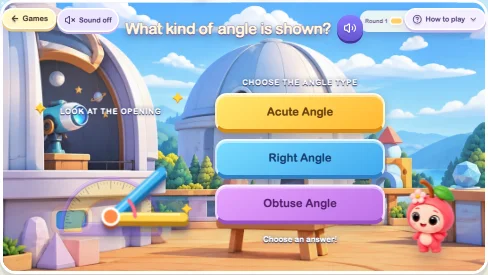
Read the scale that begins at zero on the fixed ray. Angles below 90 degrees are acute, 90 degrees is right, and angles above 90 degrees are obtuse.
Why this strategy works
An angle measures a turn from the fixed starting ray. The protractor reads that opening in degrees, and each button move changes the opening by five degrees.
Work through it step by step
- For a target of 55°, find 0° on the starting ray and locate 55° on the same scale.
- If the bridge is at 40°, raise it through 45°, 50°, and 55°.
- Check that the moving ray lines up with 55° before locking the bridge.
A mistake to watch for
Reading the opposite protractor scale gives the supplementary angle. Follow the scale that starts at zero on your fixed ray. A longer ray does not change the angle.
Try it yourself
The bridge is at 75°. How many five-degree increases reach 90°?
Show the answer and reasoning
3 increases. 90 − 75 = 15 degrees, and 15 ÷ 5 = 3. The successive readings are 80°, 85°, and 90°.
Talk about the thinking
Ask whether the target is smaller than, equal to, or larger than a right angle before making adjustments. Use that comparison to catch an incorrect scale reading.