
A guide for families and educators
Grade 4 learning guide
Fourth grade geometry asks learners to explain relationships, not only name a shape. A mirror line matches corresponding points, an angle measures a turn, and two lines can have a particular direction relationship. Use visible features to justify each decision.
Find a comfortable starting point
Begin by noticing straight edges, corners, and matching positions. A learner who can describe a quarter turn can connect it to a right angle. Read the starting ray of a protractor before measuring another ray.
Grade labels and difficulty levels are suggestions. Use the visible models, repeat a familiar activity, and stop for a break when needed.
Ideas to develop in Grade 4
- Test a line of symmetry by matching the two sides across a fold.
- Construct an angle from its starting ray using a degree scale.
- Distinguish parallel, perpendicular, and other intersecting lines.
Choose a starting activity
Read the purpose of each activity and choose the idea your learner needs. These are suggested starting points, with more choices in the subject directory.
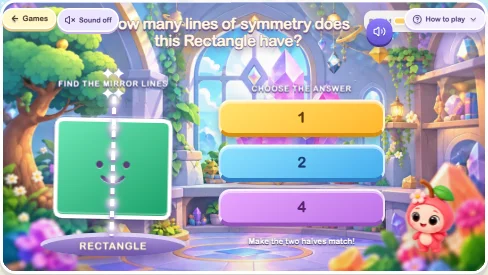 Symmetry Lab1 · Start
Check matching positions on both sides of a candidate mirror line.
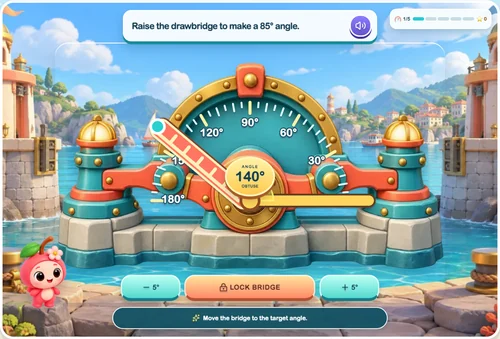 Angle Drawbridge Builder2 · Practice
Use a fixed baseline and five-degree changes to construct the requested angle.
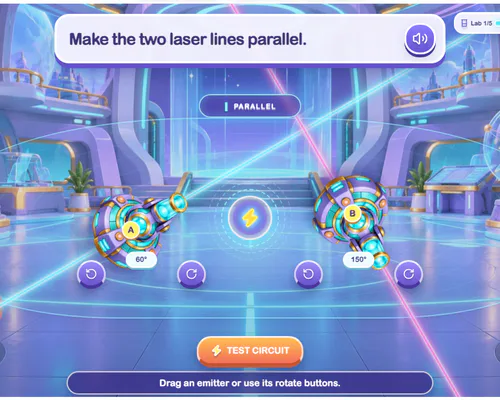 Laser Line Lab3 · Challenge
Apply angle and direction ideas to build a requested relationship between two lines.
A common stumbling block
A long ray does not make a larger angle. The angle depends on the opening between rays. Likewise, a diagonal line can be a mirror line or be perpendicular to another diagonal line; orientation on the page is not the rule.
Talk about the thinking
Ask, “Which feature proves your answer?” Encourage a fold, a right-angle corner, or a protractor reading. Guessing from the overall look of a drawing can hide the important relationship.
Help with shared play, sound, and privacy · How we build and review learning activities