Learn the math: Equal Groups of Multiplication
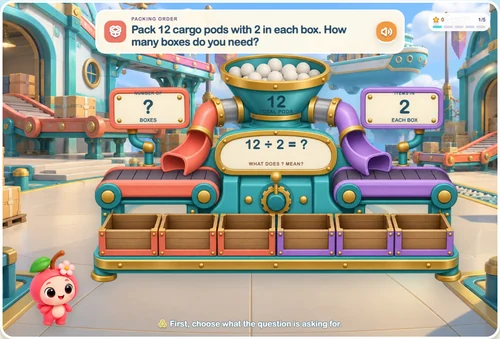
Multiplication relates the number of equal groups, the size of each group, and the total. Changing either factor can change the total.
A worked example
Five groups with 3 jellies each contain 5 × 3 = 15 jellies.
Keep in mind while you play
Separate how many groups to make from how many jellies belong in each group.
Why this strategy works
Multiplication describes a number of equal groups. The two factors have roles: how many groups to make and how many jellies belong in each group.
Work through it step by step
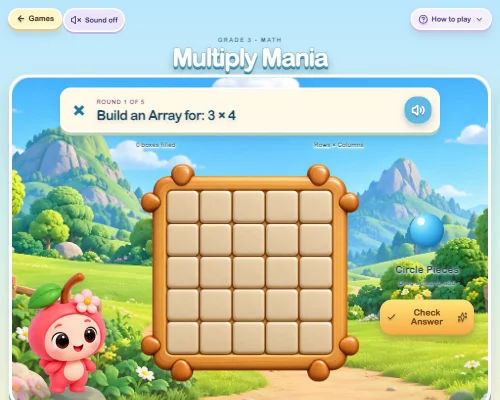
- For three groups of four, set each group to contain four jellies.
- Stamp three equal groups. Count on in fours: 4, 8, 12.
- Choose 12 as the total, and connect the model to 4 + 4 + 4 = 3 × 4 = 12.
A mistake to watch for
Adding 3 + 4 counts the two instructions, not the jellies produced. Check that every group contains four and that there are three groups altogether.
Try it yourself
How many jellies are in four groups of five?
Show the answer and reasoning
20 jellies. Each of the four groups contributes five: 5 + 5 + 5 + 5 = 20, so 4 × 5 = 20.
Talk about the thinking
Ask what changes in the picture when the two factors are exchanged. Three groups of four and four groups of three have the same total but different group structures.