
A guide for families and educators
Grade 3 learning guide
Third grade learners use equal units in several ways: steps along a number line, objects in equal groups, and fractional parts of a whole. Making the unit explicit helps children explain multiplication and fractions instead of relying on a picture alone.
Find a comfortable starting point
Check that equal steps or groups contain the same amount. Try counting by a fixed amount, and distinguish the number of groups from the amount inside each group. For fractions, begin with the endpoints zero and one.
Grade labels and difficulty levels are suggestions. Use the visible models, repeat a familiar activity, and stop for a break when needed.
Ideas to develop in Grade 3
- Read a whole-number line using its endpoints and step size.
- Connect equal groups, repeated addition, and multiplication.
- Locate a fraction by dividing one whole into equal intervals and counting from zero.
Choose a starting activity
Read the purpose of each activity and choose the idea your learner needs. These are suggested starting points, with more choices in the subject directory.
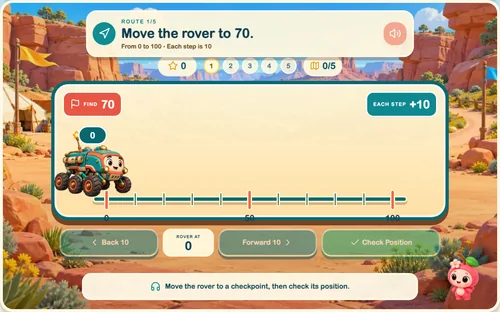 Number Line Expedition2 · Practice
Find the value of a step on a whole-number line, then locate a target checkpoint.
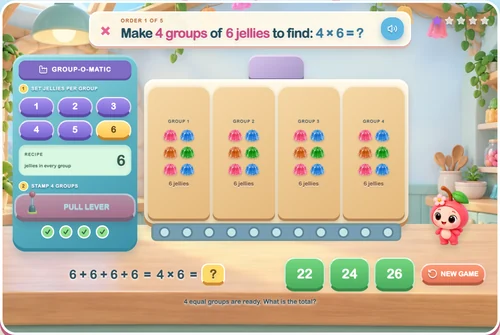 Jelly Groups Village1 · Start
Build a multiplication order with equal-sized groups and explain the total.
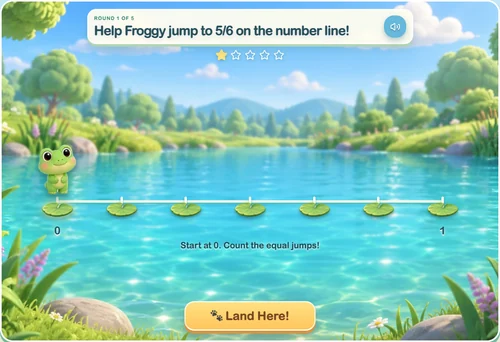 Froggy Fraction Hop1 · Start
Keep the same equal-step reasoning while changing the unit from a whole number to a fraction.
A common stumbling block
Tick marks and intervals are different. Four equal intervals between zero and one have five boundary marks. Count the spaces to name the denominator, then count forward from zero for the numerator.
Talk about the thinking
Ask, “What does one step stand for?” Use the same question for whole-number lines and fraction lines. For multiplication, ask what each factor describes in the picture.
Help with shared play, sound, and privacy · How we build and review learning activities