

Learn the math: Regrouping Addition
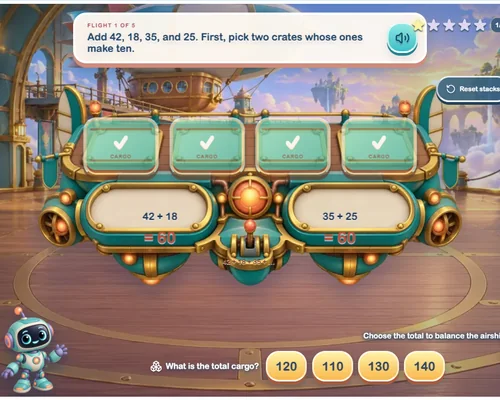
When an addition makes ten or more ones, exchange ten ones for one ten. This keeps the value unchanged while organizing the total.
A worked example
For 27 + 18, the ones total 15. Exchange 10 ones for a ten, leaving 5 ones; 2 + 1 + 1 tens gives 45.
Keep in mind while you play
Remember to include the new ten when adding the tens column.
Why this strategy works
Regrouping keeps the total unchanged while replacing ten ones with one ten. The new ten joins the tens already in the calculation.
Work through it step by step
- For 27 + 15, combine the ones: 7 + 5 = 12 ones.
- Exchange ten of those ones for one ten. Keep the two remaining ones.
- Combine 2 tens + 1 ten + the new 1 ten = 4 tens. Four tens and two ones make 42.
A mistake to watch for
Writing 12 in the ones place or forgetting the new ten loses the place-value structure. Show where all twelve ones went: ten in the new bundle, two left over.
Try it yourself
What is 36 + 28?
Show the answer and reasoning
64. 6 + 8 = 14 ones, which become 1 ten and 4 ones. The tens total is 3 + 2 + 1 = 6, so the sum is 64.
Talk about the thinking
Ask your learner to explain the small carried 1 using the words one ten. Check whether the final answer is reasonable compared with 30 + 30.