
A guide for families and educators
Grade 2 learning guide
Second grade place value explains why written addition and subtraction work. Ten ones can become one ten, and one ten can be exchanged for ten ones without changing the amount. Use these exchanges to connect a visual model to each step of a calculation.
Find a comfortable starting point
Ask your learner to build a number using hundreds, tens, and ones, then name what each digit means. Before regrouping, check that ten ones and one ten are understood as equal amounts.
Grade labels and difficulty levels are suggestions. Use the visible models, repeat a familiar activity, and stop for a break when needed.
Ideas to develop in Grade 2
- Build and read three-digit numbers using place-value units.
- Regroup an addition by bundling ten ones into a ten.
- Regroup a subtraction by exchanging one ten for ten ones, while keeping the total unchanged.
Choose a starting activity
Read the purpose of each activity and choose the idea your learner needs. These are suggested starting points, with more choices in the subject directory.
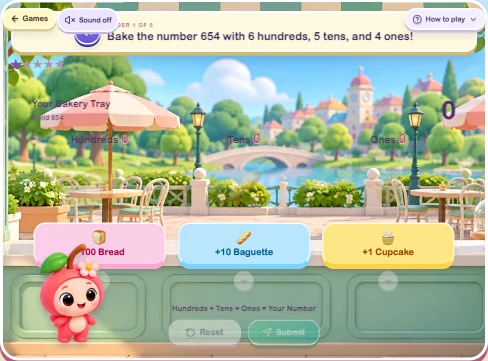 Place Value Bakery1 · Start
Build the requested number from hundreds, tens, and ones before working with column calculations.
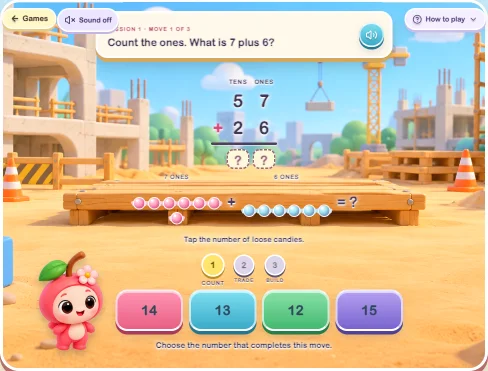 Carry Candy Crane2 · Practice
Bundle a group of ten ones and include the new ten in the final total.
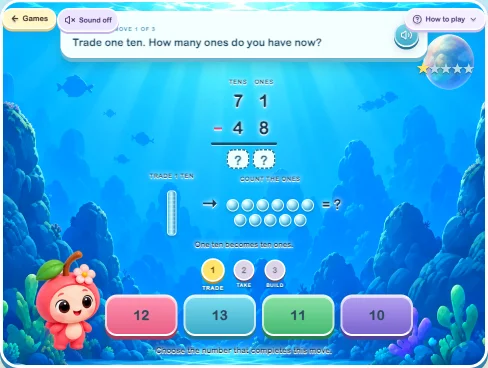 Borrow Bubble Sub3 · Challenge
Exchange a ten when there are too few ones to subtract, and check the result with addition.
A common stumbling block
An exchange changes two columns together. In 52, trading one ten gives four tens and twelve ones. Keeping five tens as well would create a different starting number.
Talk about the thinking
Ask, “Where did that new ten come from?” or “How much is the number worth after the trade?” Check subtraction by adding the difference and the amount removed.
Help with shared play, sound, and privacy · How we build and review learning activities