
A guide for families and educators
Grade 1 learning guide
First grade practice builds useful relationships between numbers. Making ten, comparing two groups, and checking both sides of an equation help children move beyond counting everything from one. Encourage a drawing or object model before asking for a quicker mental strategy.
Find a comfortable starting point
Start with quantities up to ten and ask your learner to show a number in two parts. Counting on from a known amount is useful preparation for addition. Matching objects in pairs prepares children to find how many more.
Grade labels and difficulty levels are suggestions. Use the visible models, repeat a familiar activity, and stop for a break when needed.
Ideas to develop in Grade 1
- Use complements of ten to reason about addition and subtraction.
- Find a difference by matching quantities and identifying the unpaired part.
- Treat the equal sign as a statement that both sides have the same value.
Choose a starting activity
Read the purpose of each activity and choose the idea your learner needs. These are suggested starting points, with more choices in the subject directory.
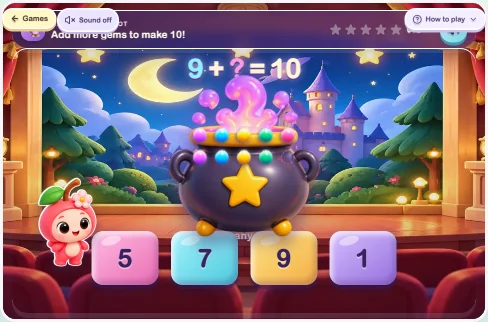 Make 10 Magic Pot1 · Start
Find the part missing from ten, using the visible gems as support.
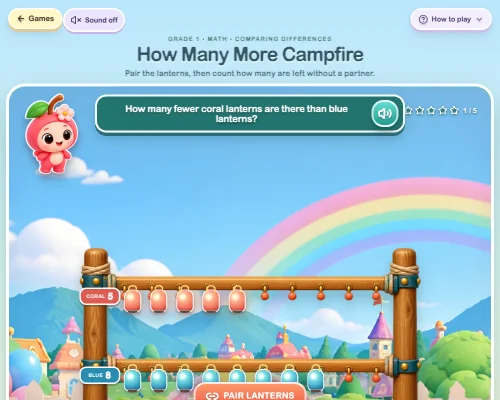 How Many More Campfire2 · Practice
Match lanterns one to one, then use the leftovers to explain a difference.
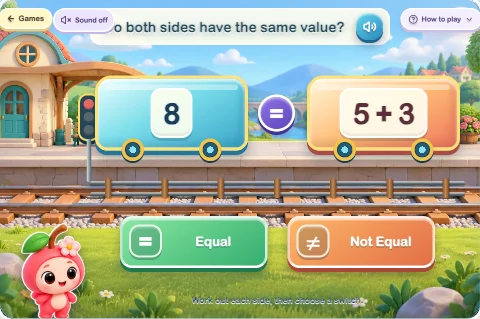 Equal Sign Switchyard3 · Challenge
Compare the values of two expressions and explain why an equation is equal or not equal.
A common stumbling block
Children sometimes read the equal sign as “write the answer next.” Compare expressions on both sides, including equations where both sides contain an addition. Ask for the value of each side before deciding.
Talk about the thinking
Ask, “Can you show that another way?” A ten-frame, paired objects, and a number sentence can describe the same relationship. Let your learner choose the representation that makes sense first.
Help with shared play, sound, and privacy · How we build and review learning activities