
A guide for families and educators
Pre-K learning guide
Early math starts with noticing: how many animals are here, which shape fits, and what changes when objects move. Give your child time to point, move, compare, and describe before asking for a numeral. An adult can read the directions and share the play.
Find a comfortable starting point
Begin with a small group of objects your child can touch or point to. If counting words are still unfamiliar, say each word together. Recognizing every written number is not needed to explore shapes, position, or size.
Grade labels and difficulty levels are suggestions. Use the visible models, repeat a familiar activity, and stop for a break when needed.
Ideas to develop in Pre-K
- Match one counting word to one object, and use the last word to tell the total.
- Compare shapes, positions, lengths, and amounts using visible clues.
- Notice a repeating rule, remember a short sequence, and explain a choice with words or gestures.
Choose a starting activity
Read the purpose of each activity and choose the idea your learner needs. These are suggested starting points, with more choices in the subject directory.
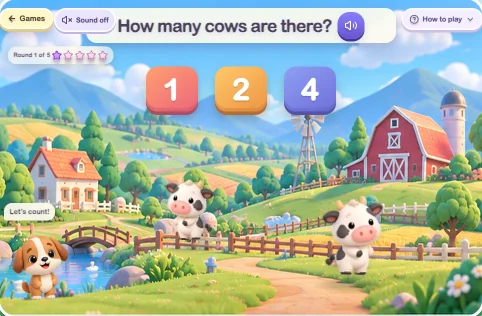 Animal Friends1 · Start
Start with one-to-one counting of one to five animals. Touch each animal once, then name the total.
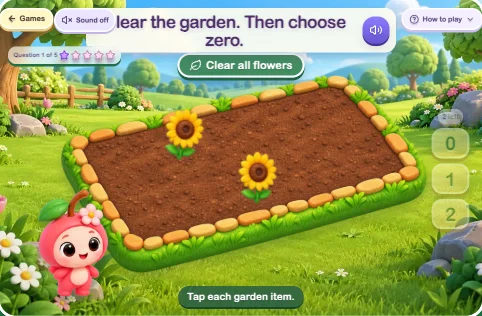 Zero Hero Garden2 · Practice
Explore the special case of none. Clear a group and connect the empty garden to the numeral zero.
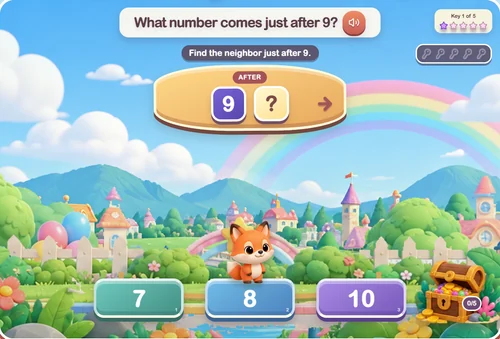 Number Neighbor Treasure Run3 · Challenge
When counting is comfortable, use the counting order to find the number just before or after a clue.
A common stumbling block
A spread-out group can look bigger even when it contains the same number of objects. Move the objects closer together and count again. Keep the group small enough that your child can track every item.
Talk about the thinking
Ask, “How do you know?” Accept pointing or moving an object as an explanation. After play, count a few spoons or compare two toy roads together.
Help with shared play, sound, and privacy · How we build and review learning activities