
A guide for families and educators
Kindergarten learning guide
Kindergarten practice connects spoken number names, written numerals, and quantities. A ten-frame makes those quantities visible: children can see both the filled spaces and the spaces still needed. Keep objects and drawings available while children explain their thinking.
Find a comfortable starting point
Try recognizing a few numerals and counting a small collection without skipping an object. If either task is difficult, revisit it with objects before working out a missing part. A familiar game can be repeated without moving up a grade.
Grade labels and difficulty levels are suggestions. Use the visible models, repeat a familiar activity, and stop for a break when needed.
Ideas to develop in Kindergarten
- Connect a numeral to its spoken name and a group of objects.
- Compose and separate small totals, including pairs that make ten.
- Describe shapes, measurement comparisons, patterns, time, and simple data with concrete examples.
Choose a starting activity
Read the purpose of each activity and choose the idea your learner needs. These are suggested starting points, with more choices in the subject directory.
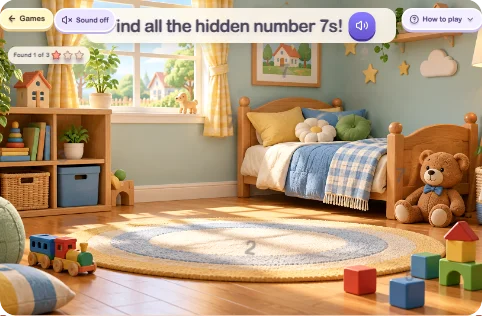 Number Hunt1 · Start
Connect a spoken number to its numeral, even when matching numerals appear in different places.
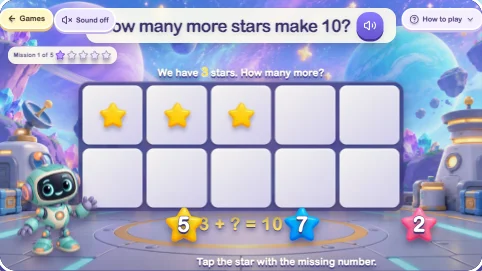 Ten Frame Galaxy1 · Start
Use ten visible spaces to connect a filled part and a missing part to the whole of ten.
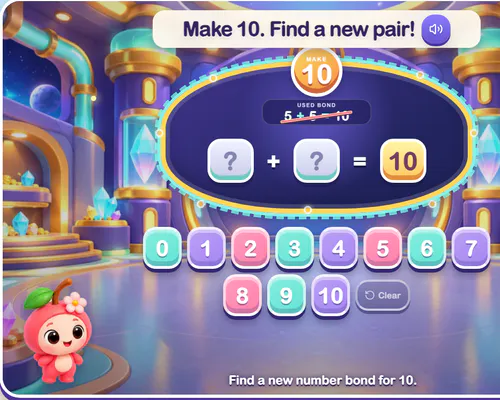 Number Bond Vault3 · Challenge
Find a different pair for the same total. Explain how both parts work together.
A common stumbling block
Recognizing the symbol 7 does not yet show that a child can make a group of seven. Ask for seven counters, then rearrange them. When finding a missing part of ten, count empty spaces rather than restarting the total at one.
Talk about the thinking
Ask, “What stayed the same when you moved the counters?” For a new number bond, ask how one part could change while the total stays fixed.
Help with shared play, sound, and privacy · How we build and review learning activities